
Why Has My Company Received a CRO Strike-Off Notice?
If you are one of the many thousands of directors of Irish companies who have recently received a strike-off notification from the CRO, you are certainly not alone.
The CRO has significantly increased its enforcement activity in relation to companies with outstanding filing obligations and has indicated its intention to commence strike-off proceedings against all delinquent companies by year-end.
If your company has received a statutory strike-off notice, it is important to act promptly. The notice will outline the reason for the proposed strike-off and the steps that can be taken to prevent the company from being removed from the register.
How Long Do I Have Before My Company Is Struck Off?
The strike-off process follows a strict statutory timeline.
Not less than 28 days after the statutory strike-off notice is issued, a notice of impending strike-off will be published in the CRO Gazette. The company may then be struck off not less than 28 days after publication.
In practical terms, this means that a company typically has approximately 56 days from the date of the initial strike-off notice to address the issue and prevent dissolution.
See Timeline Below:
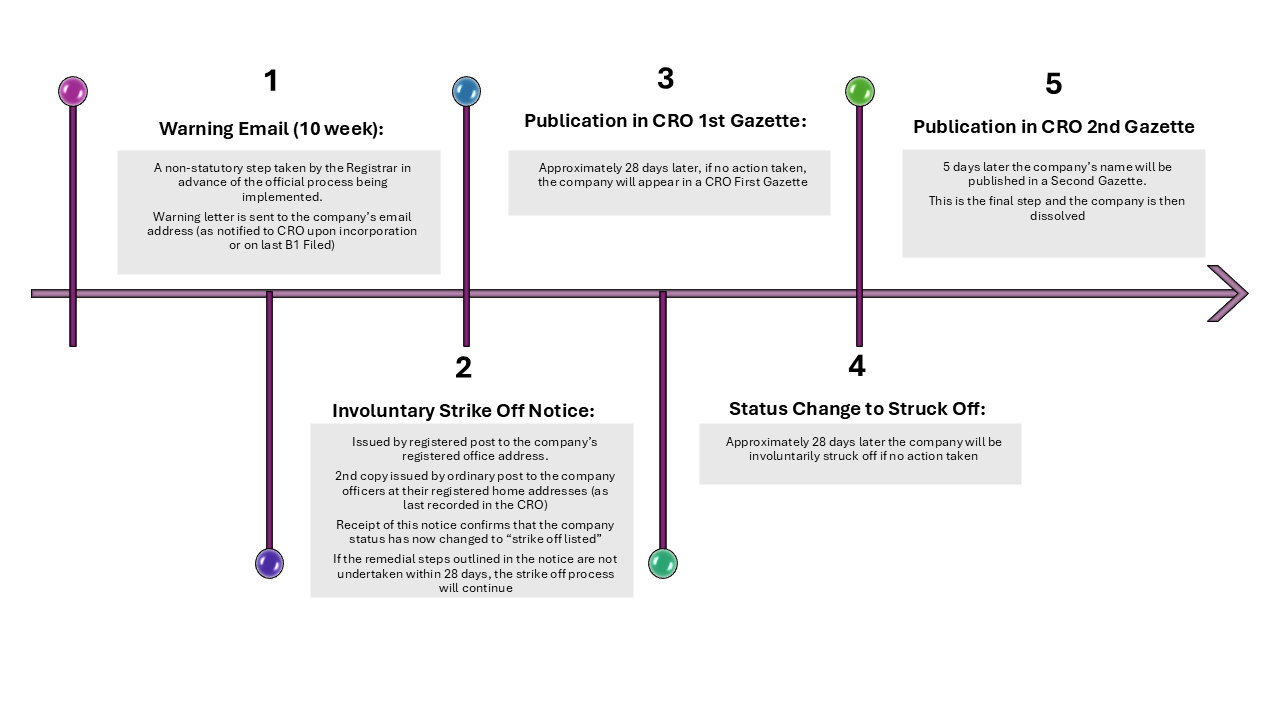
Disclaimer: The 10-week warning letter is not part of the statutory strike-off process and may not be issued in every case. Directors should act immediately upon receipt of any CRO strike-off notice.
What Should I Do If I Receive a Strike-Off Notice?
The most important thing is not to ignore the notice.
Step 1: Identify the Reason for the Strike-Off
Carefully review the notice and determine the grounds on which the CRO has initiated strike-off proceedings.
Common reasons include:
- Overdue annual return filings
- Failure to file a Form 11F (Statement of Particulars) with Revenue
- Other grounds can also apply, such as the absence of an EEA-resident director or a company secretary, although these are less common.
If the Issue relates to Revenue Form 11F
Where the strike-off is due to a failure to file the Form 11F with Revenue, this should be addressed immediately.
Once the filing has been completed, the strike-off process will generally be halted.
VIEW REVENUE COMMISSIONERS’ GUIDANCE ON FORM 11F (STATEMENT OF PARTICULARS)
Step 2: Speak With Your Accountant
If the strike-off relates to outstanding annual returns, your accountant should generally be your first point of contact.
With the exception of a company’s first six-month annual return, financial statements must accompany annual return filings.
In addition, if a company has previously filed late, it may have lost its audit exemption, resulting in a requirement to prepare audited financial statements for subsequent years.
As annual returns cannot be completed until the financial statements have been prepared and approved, engaging with your accountant early is essential.
Step 3: File Annual Returns and Bring the Company Back into Compliance
Once the financial statements have been prepared, any outstanding annual returns should be filed as soon as possible to prevent the strike-off process from progressing.
CFI’s Company Secretarial team can assist with the preparation and filing of overdue annual returns, liaise with your accountant where required, and help ensure all CRO filing requirements are met.
LEARN MORE ABOUT OUR ANNUAL RETURN FILING SERVICES FOR IRISH COMPANIES
Applying to the District Court for Additional Time to File (Section 343 Extension)
In certain circumstances, a company may apply to the District Court under Section 343 of the Companies Act 2014 for additional time to complete outstanding filings.
Where an application is successful and the company complies with the Court’s deadline, outstanding annual returns are treated as having been filed on time. This means:
- Late filing penalties do not apply.
- The company may avoid the loss of audit exemption.
However, Section 343 is a discretionary remedy. The Court must be satisfied that there were genuine and extenuating circumstances which prevented the company from meeting its filing obligations.
The CRO may object to an application where the reasons provided amount to:
- Inadvertence
- Miscommunication
- Oversight
Accordingly, directors should carefully assess whether they have sufficient evidence to support an application before proceeding.
Timing Is Critical
Even where extenuating circumstances exist, directors should consider the timing carefully.
The affidavit must be prepared and sworn, original documentation returned, the Court application lodged, and the CRO served with notice, all before the company is struck off.
A company that has already been struck off cannot avail of this remedy.
Once a strike-off notice has issued, the timeframe for taking the necessary steps is often extremely tight, making early action and timely decision-making essential.
Considering a Section 343 application?
CFI can offer you a friendly and professional service guiding you through every step of the Section 343 process and arrange for appropriate legal representation on your behalf.
What If My Company Has Already Been Struck Off?
If the company is unable to resolve the issue before the strike-off takes effect, all may not be lost.
Depending on the circumstances, it may be possible to restore the company to the register.
Where the strike-off occurred within the previous 12 months, an Administrative Restoration may be available.
LEARN MORE ABOUT ADMINISTRATIVE RESTORATION
Consequences of Involuntary Strike-Off
For companies that are still trading, involuntary strike-off can have serious legal and commercial consequences.
The company ceases to exist as a legal entity, assets may vest in the State, and significant complications can arise in relation to contracts, banking arrangements, property ownership, and ongoing business operations.
READ THE CRO GUIDANCE ON THE CONSEQUENCES OF INVOLUNTARY STRIKE-OFF
Need Help Responding to a Strike-Off Notice?
If your company has received a strike-off notice, it is important to take action as soon as possible. The available options will depend on the reason for the strike-off and the time remaining before the company is dissolved.
CFI can assist with annual return filings, liaise with your accountant where required, and advise on the options available to restore your company’s compliance position.
Contact our Company Secretarial team today via our ONLINE ENQUIRY FORM or call (01) 664 1177 to discuss your options and the most appropriate next steps.
Disclaimer: This article is for general informational purposes only. All content is provided in good faith; however, we make no representation or warranty of any kind regarding the accuracy, adequacy, validity, reliability, availability, or completeness of any information. All or any information is subject to change. This post does not constitute legal, financial, or professional advice. Always seek the advice of a qualified professional or legal advisor with any questions you may have. CFI are not liable for any loss or damage arising from your use of the information contained in this Article.
For More Information:
Company Formations |
Company Secretarial |
Annual Returns |
Register of Beneficial Owners |