
Companies Registration Office (CRO) Update – Increase Of Involuntary Strike Off Action
At the most recent Companies Registration Office (CRO) Stakeholders Forum, held in June 2026, it was revealed that the CRO is now actively targeting approximately 1,000 non-compliant companies per week for involuntary strike-off action.
The CRO has also stated that its objective is to commence strike-off proceedings against all companies currently in default by the end of the year.
With 4,011 companies currently listed as “Strike Off Listed”, enforcement activity is clearly increasing.
For company directors, business owners and professional advisers, this is a timely reminder to address any outstanding annual returns and statutory filing obligations before formal enforcement action begins.
CRO Involuntary Strike-Off Process
The CRO has published a helpful overview of the involuntary strike-off process, which we have summarised below:
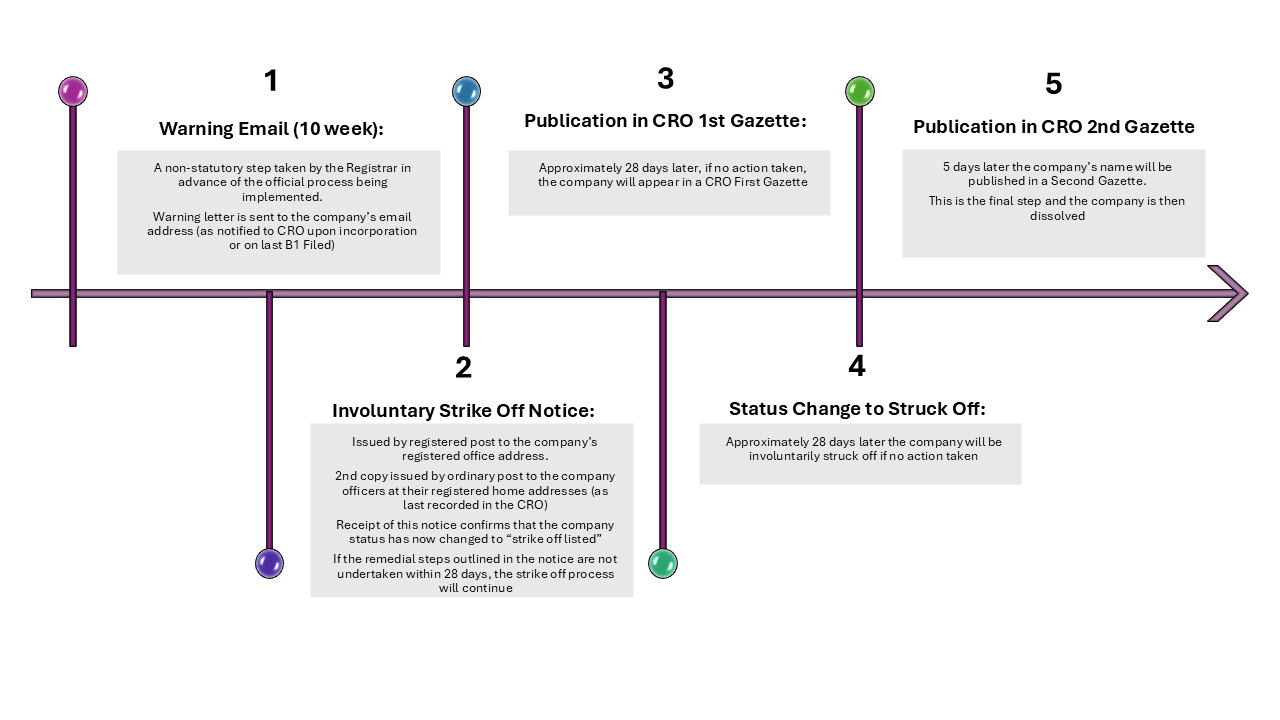
*Estimated Timelines: Company is normally struck off 56 days after the issue of the official involuntary strike off notice
What Happens When a Company Is Struck Off?
Where a company is struck off the register involuntarily, a range of legal and administrative consequences may arise.
These can include:
Complications with company assets: If the company has any assets on its dissolution date, technically they become the property of the State;
Loss of Limited Liability: Upon dissolution, the Company ceases to exist as a legal entity . The protection of limited liability is lost with effect from their dissolution date, and if the business formerly carried on through the company is continued, the owners are trading in their personal capacity and take on personal liability;
Complications with Bank Accounts: When a company is struck off its bank will freeze any accounts which it holds, which causes obvious difficulties for day to day trading.
Business Reputation: The company and its Directors will suffer reputational damage in the wider business community and with credit ratings agencies who may down grade their score;
Further Legal Action: Where a company has been struck off for failure to file annual returns, application may be made to the High Court by the Corporate Enforcement Authority (CEA) for an order pursuant to section 842(h) Companies Act 2014, disqualifying the company’s directors from acting as directors or having any involvement in the management of any company;
Which Companies Are Currently at Risk?
A company that is only one year behind with its annual return filings may be selected for involuntary strike-off.
However, attendees at the CRO Stakeholders Forum were advised that current enforcement efforts are primarily focused on companies that have not filed annual returns since 2019 or earlier.
Given the accelerated level of enforcement activity, it is expected that the CRO will move through subsequent filing years relatively quickly. Companies that may have avoided attention in the past should not assume this position will continue indefinitely.
The safest approach is to bring any outstanding filings up to date as soon as possible.
How CFI can Help:
CFI provide a range of support services in relation to CRO compliance and strike‑off matters, including:
- Preparation and filing of outstanding Annual Returns
- Liaison with accountants regarding the preparation and audit of Financial Statements, where required
- Restoration of companies to the register following strike off
- Preparation of Section 343 applications to the District Court, which can:
- Extend the Annual Return Date
- Remove late filing penalties
- Restore audit exemption
- Ongoing support through our Company Secretarial Maintenance program, ensuring statutory filing deadlines are continually monitored and managed.
If you would like more information on any of the above services, please contact us at [email protected] or through our contact form HERE
Disclaimer: This article is for general informational purposes only. All content is provided in good faith; however, we make no representation or warranty of any kind regarding the accuracy, adequacy, validity, reliability, availability, or completeness of any information. All or any information is subject to change. This post does not constitute legal, financial, or professional advice. Always seek the advice of a qualified professional or legal advisor with any questions you may have. CFI are not liable for any loss or damage arising from your use of the information contained in this Article.
For More Information:
Company Formations |
Company Secretarial |
Annual Returns |
Register of Beneficial Owners |
